
Hey there,
This week's newsletter focuses on practical AI implementations. Our main tutorial breaks down AI agents into simple, understandable components - no fancy frameworks needed. We're also looking at Anthropic's new Economic Index, which provides actual data on how companies are using AI today, and we'll show you how to run vision AI locally with SmolVLM's impressively small models.
Plus: Our take on finding realistic AI use cases that actually save time.
Enjoy the read!
Cheers, Andreas & Sascha
In todays edition:
📚 Tutorial: Build AI Agents Without Frameworks: A step-by-step guide to creating agents using plain Python
🛠️ Tool of the Week: Aider: Why it's currently the best AI coding assistant
📊 Top News: Anthropic's Economic Index: First real data on how companies actually use AI
💡 Also in the News: Microsoft's OmniParser V2 for GUI automation and xAI releases Grok 3
💪 Tip of the Week: SmolVLM: Run vision AI locally with just 256MB
Let's get started!
Tutorial of the week
Build AI Agents From Scratch – No Frameworks Needed!

This week, we're once again talking about AI Agents. No wonder - these systems are one of the major value propositions of AI. We’re showing you how to build one without relying on complex frameworks like LangChain or AutoGPT. Why go framework-free? Because understanding the fundamentals gives you ultimate control, easier debugging, and better performance.
What You'll Learn (and Why It Matters):
The linked blog post breaks down agent creation into its essential components. You can create an agent that can, for example, query PostgreSQL databases and search Wikipedia, all with clean, understandable Python code.
- The Core Concept of AI Agents: It's simpler than you think! An agent is essentially a language model that can: Understand available "tools" (like database queries or web searches). Decide when to use those tools. Remember past interactions (though this is optional, and often unnecessary!). Make decisions based on all of this information.
- Tools are Just Functions: The article explains "tools" by showing they're simply Python functions with clear descriptions, inputs, and outputs.
- The Agent Interaction Loop: The tutorial then shows and implements the major ‘secret sauce’ of agents - the agent loop: User input is received. The LLM decides if a tool is needed. If so, the tool is executed. The LLM formulates a response, potentially using the tool's output. Repeat until done.
- Why Skip the Framework? While frameworks can speed up initial prototyping, the article highlights the significant benefits of a from-scratch approach: Transparency: You see exactly what the LLM is being told, how decisions are made, and when tools are called. Flexibility: Customize everything – prompts, tool structure, memory – without fighting the framework. Debugging: Pinpoint errors quickly because you control the entire process. Frameworks adds unneccessary complexity. Performance: Load only what you need, optimizing for your specific use case.
Who Should Read the Full Tutorial:
- Technical Managers: Gain a deep understanding of agent architecture to make informed decisions about AI projects.
- CEOs: Understand AI agents and see how they can be built with clear, manageable code, not just magic black boxes.
- Anyone building production-ready AI agents: This framework-free approach is ideal for systems where control, reliability, and performance are of major concern. Or at least a great starting point for anyone wanting to learn how agents work.
Read the full tutorial in the link below.
How to Build AI Agents Without Frameworks: A Step-by-Step GuideComprehensive tutorial for no-framework AI agent development using direct LLM interaction. Build smarter, more adaptable AI systems without the constraints of pre-built toolswww.pondhouse-data.com/blog/ai-agents-from-scratch →
Tool of the week
Aider - the best AI coding assistant
Creating code is probably one of the best-researched and most stable use-case for AI. While there are still some kinks to work out - AI models are generally very impressive when it comes to creating code.
According to our own tests, the best coding assistant at the moment is Aider. While its terminal-based interface might seem basic, Aider stands out due to its exceptional performance and reliability, particularly when paired with Claude 3.5 Sonnet and o1. It consistently outperforms other AI coding tools in real-world development tasks, scoring among the highest on the SWE Bench, a challenging software engineering benchmark.
Key Features:
- Best-in-class Multi-file editing capabilities
- Works with most popular programming languages
- Compatible with leading LLMs (Claude 3.5 Sonnet, DeepSeek, GPT-4o)
- Maintains context of your entire git repository
Why It's Special:
- Top Performance: Ranks among the highest on SWE Bench, solving real GitHub issues from major open-source projects
- Simple Setup: Quick installation via pip and straightforward configuration
- Practical Integration: Works alongside your favorite editor or IDE
- Voice Coding Support: Code with voice commands
- Extensive Compatibility: Supports various LLMs, including local models
Pro Tip: For best results, try it with Claude 3.5 Sonnet or GPT-4o. The tool truly shines when handling complex codebase modifications and multi-file changes.
🔍 Why we recommend it: Among the numerous AI coding assistants we've tested, Aider consistently delivers the most practical and reliable results. Its terminal-based approach might seem basic, but it's precisely this simplicity that makes it so effective for real-world development tasks.
Homeaider is AI pair programming - best in class!aider.chat →
Top News of the week
Anthropic's Economic Index Reveals Real-World AI Usage Patterns
Based on millions of anonymized conversations with Claude.ai, Anthropic released a highly intersting study, offering concrete data about AI usage in the economy rather than speculative forecasts.
Key Findings:
- 36% of occupations use AI for at least a quarter of their tasks
- Only 4% of jobs use AI for three-quarters or more of their tasks
- AI usage splits between augmentation (57%) and automation (43%)
- Highest adoption in mid-to-high wage technical roles
- Software development and technical writing lead current usage
Most Interesting Insight: Rather than fully automating jobs, AI is being selectively adopted for specific tasks across different occupations. The data suggests we're heading toward job evolution rather than wholesale replacement.
Usage Distribution:
- Computer & Mathematical: 37.2%
- Arts & Media: 10.3%
- Education & Library: 9.3%
- Office & Administrative: 7.9%
- Life Sciences: 6.4%
Implications for Business Leaders: The data suggests focusing on strategic AI integration for specific high-value tasks rather than complete process automation. Mid-level technical roles appear to be the sweet spot for current AI implementation.
Why It Matters: This isn't speculation. It's real-world data. It shows AI is currently a collaborative tool, impacting specific tasks in mid-to-high wage jobs, not wholesale job replacement. The Index will be updated regularly, providing more insights for all of us. It moves beyond theory to show specific current adoption patterns.
The Anthropic Economic IndexAnnouncing our new Economic Index, and the first results on AI use in the economywww.anthropic.com/news/the-anthropic-economic-index →
Opinion: Stop Looking for AI Unicorns, Start Finding Minutes
Also in the news
Microsoft Releases OmniParser V2: AI Gets Better at Using Computers
Microsoft Research has launched OmniParser V2, an upgrade that allows LLMs to better interact with graphical user interfaces. The tool achieves a 60% reduction in latency compared to its predecessor and dramatically improves accuracy in detecting small interface elements.
Key points:
- Increases GPT-4o's GUI interaction accuracy from 0.8% to 39.6%
- Works with major LLMs including GPT-4o, Claude Sonnet, and DeepSeek
- Available as a dockerized Windows system (OmniTool)
This development could accelerate the development of AI agents that can effectively operate computer interfaces, potentially leading to more sophisticated automation tools. More in their announcement blog post.
xAI Releases Grok 3 with Bold Claims
xAI has launched Grok 3, claiming it's "the world's smartest AI." The model introduces two new features: DeepSearch for information synthesis and Think for enhanced reasoning. While available free initially, premium access will be restricted to X Premium+ and SuperGrok subscribers.
Editor's Note: While xAI's marketing claims are notably ambitious, independent testing hasn't validated their performance claims. Nevertheless, early user feedback suggests Grok 3 is a capable model, even if not quite the revolution advertised.
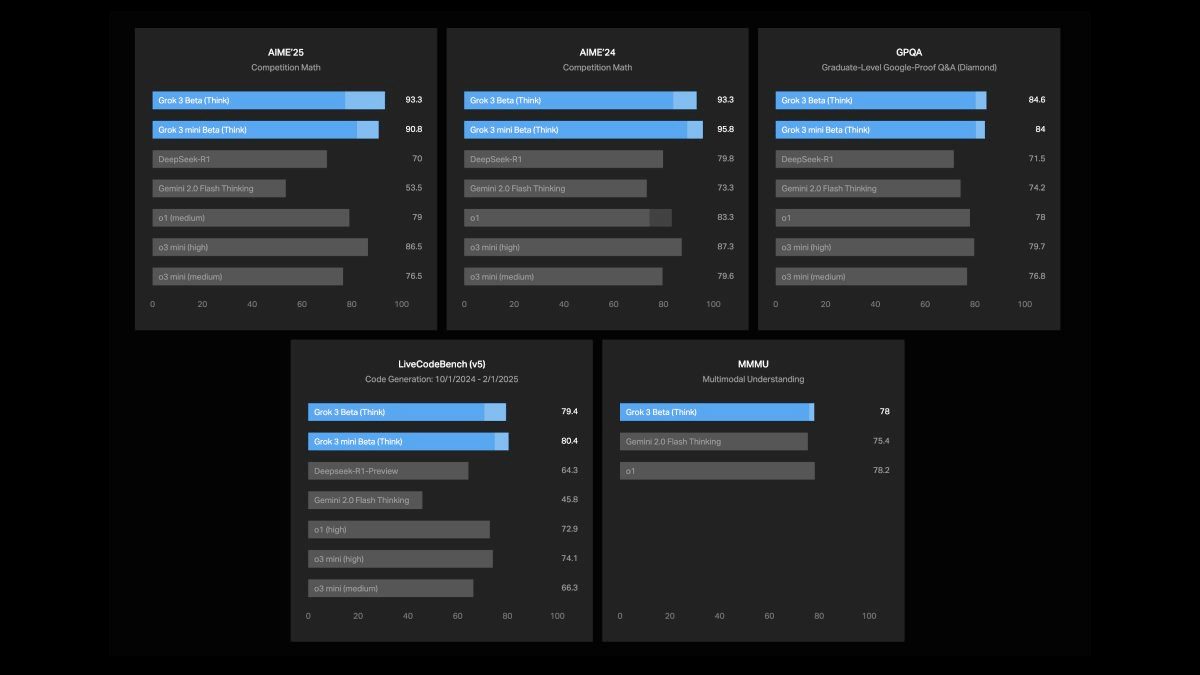
xAIs Benchmark results seem impressive (xAI vendor benchmarks)
Tip of the week
Run Vision AI on Your Phone: SmolVLM Makes It Possible
Want to experiment with vision AI locally? The new SmolVLM models (256M and 500M) from Hugging Face make it possible to run sophisticated vision-language models on consumer devices, including phones. Here's why this matters and how to get started.
Why It's Important:
- Ship AI with your app: Bundle a 400MB model like you would a database
- Deep integration: AI becomes a native feature, not an external service
- Simplified architecture: No complex cloud dependencies or API management
- Cost predictability: One-time cost (model size) vs ongoing API expenses
- Offline-first design: AI features work regardless of connectivity
Development Implications:
Due to the very small size - but very good performance, developers benefit in many ways:
- Treat AI like any other library or component
- Focus on features rather than infrastructure
- Simplify testing and deployment
- Reduce dependency on external services
Quick Start Guide:
Pro Tip: For mobile devices, use the WebGPU version available here. It's optimized for mobile hardware and runs directly in your browser.
This approach helps normalize AI as just another tool in our software development toolkit - not a mysterious cloud service requiring special infrastructure and ongoing costs.
SmolVLM Grows Smaller – Introducing the 256M & 500M Models!We’re on a journey to advance and democratize artificial intelligence through open source and open science.huggingface.co/blog/smolervlm →
We hope you liked our newsletter and you stay tuned for the next edition. If you need help with your AI tasks and implementations - let us know. We are happy to help