
Hey there,
This week, OpenAI found 948 Linux root exploits in one automated scan, at about $1,279 each. The tutorial is our own: a Kuken-style search for engineering drawings, tested on scans from 1909. The tool of the week, Modern Web Guidance, comes from the browser makers and teaches coding agents current web APIs.
We'll also look at IBM's markup against prompt injection, METR's 1.9× estimate for Anthropic, Google's cheaper Gemini 4 Hydrogen, Google's Decisions API, and a tip for agent memory with a paper trail.
Enjoy the read!
Cheers, Andreas & Sascha
📚 Tutorial of the week
Find Any Engineering Drawing by Number, Parts List or Photo
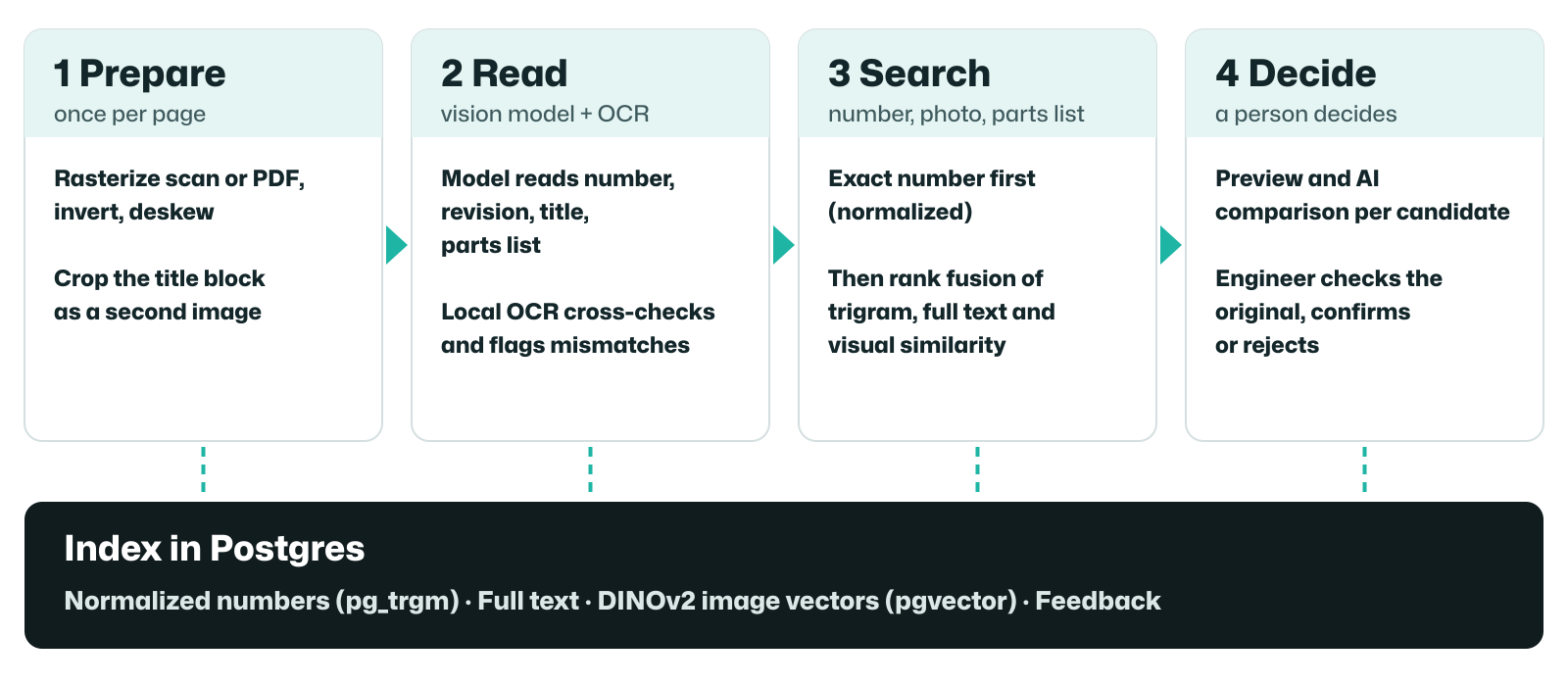
Customers keep asking us whether AI can make their old engineering drawings searchable. Kuken Industries, a Japanese maker of cooling towers, has done it for more than 70 years of drawings but has not published how. So we rebuilt the pattern in about 600 lines of Python and tested it on 74 generated drawings and 60 real scans from 1909 out of the US National Archives.
- Read each page once:
gpt-6.1-terragets the whole sheet plus a crop of the title block and returns drawing number, revision, title and parts list as structured output, for about 0.6 cents per page. A local OCR pass with RapidOCR cross-checks the numbers and flags pages where the two disagree. - Describe every title-block layout: on the 1909 sheets, the model took a filing box labeled INDEX for the revision on 27 of 60 pages. One sentence about that layout in the prompt brought it down to 0.
- Normalize numbers on both sides:
KT-2041-03,KT 2041/03,KT204103andkt-2041-3are the same drawing. Normalization plus trigram search in Postgres took the hit rate for messy notations from 0 to 100%. Transposed digits stay the weak spot. - Upload a parts list instead of typing: for the 33 lines whose drawing was in the archive, the right one came first 30 times. For 7 standard parts that were not in the archive, the search never claimed an exact match.
- Use image search for the kind of part: DINOv2 vectors in pgvector found the right kind of part 87% of the time and the exact part only 27%.
All test runs together cost $1.55. If you want to try this on your own archive, start with a hand-checked sample of 200 to 500 pages from every era and title-block layout. Without that answer key you cannot tell whether the search works.
Engineering drawing search with AI: what Kuken built and how to build your ownHow to make engineering drawings searchable with a vision model, OCR, Postgres and image vectors, with code and test results.Pondhouse Data →🛠️ Tool of the week
Browser Makers Teach Coding Agents the Modern Web
Coding agents learned the web from years of old code, so they reach for heavy JavaScript where a native API would do. Modern Web Guidance is a set of skills, stewarded by the Google Chrome, Microsoft Edge, Mozilla Firefox and MDN teams, that loads curated guides and compatibility data into the agent's context when it needs them.
- Try it without installing:
npx modern-web-guidance@latest search "animate a dialog modal backdrop"finds a guide,retrieveloads one by ID, andlegacy-scan .looks for legacy patterns in your codebase.installruns a setup wizard. - Coverage: 250 web features and 203 developer use cases, from container queries and View Transitions to the Popover API, Anchor Positioning and the built-in AI APIs.
- Reported effect: in the project's own evaluation snapshot from 8 November, pass rates rose from 58% to 94% with Antigravity, 54% to 82% with Codex, and 57% to 88% with Claude Code.
- Telemetry: search runs locally and needs no API key, but anonymous telemetry includes agent names and the agent's search queries.
DISABLE_TELEMETRY=1turns it off.
It costs little to try on your next frontend task. On an older codebase, legacy-scan alone gives a quick picture of what could be modernized.
📰 Top News of the week
948 Linux Root Exploits at About $1,279 Each
In a research post on 4 November, OpenAI describes a pipeline that scans selected Linux kernel code, reproduces each candidate bug in an isolated virtual machine, tests whether it can be exploited, drafts a patch, and passes the result to human reviewers. The run, in mid-October, used an upcoming cyber model.
- The funnel: 2,308 candidate findings, 1,724 reproduced dynamically, 948 distinct local privilege-escalation (LPE) exploits, and 291 information-leak proofs of concept.
- The bill: $1,213,430 in API credits, which OpenAI puts at about $1,279 per LPE.
- People in the loop: researchers reviewed the outputs before anything was reported.
- The patch gap: after the ten-day scan, 61 LPEs had been patched upstream, 43 had staging patches and 299 were being discussed publicly. Most of the 948 were not fixed yet.
All of these are OpenAI's own figures. At about $1,279 per exploit, finding kernel bugs is now cheap and fast, and patching and rolling out the fixes is what takes time. Keep kernels and base images on a short update cycle.
A thousand fewer paths to rootOpenAI's report on an automated pipeline that found, reproduced and exploited Linux kernel bugs, with costs and patch status.OpenAI →Also in the news
IBM's LLMON Tags Which Text Is Instruction and Which Is Data
IBM released LLMON on 12 November, a markup format that uses reserved special tokens to separate instructions, data, requirements and output, with an execution block that ties them together. It comes with experimental Granite 4.1 3B and 8B preview models and an Apache-2.0 toolkit with converters and examples. On the OPI indirect prompt-injection benchmark, IBM reports that its models avoided 47% more attacks than the best frontier model it tested and 95% more than the best open model. IBM says plainly that the behavior is learned, not enforced, so tool permissions and isolation are still what protects you.
🔗 LLMON: An LLM-Native Markup Language, now in Granite 4.1 3B and 8BMETR: Anthropic's Model Progress Runs About 1.9× Faster
METR examined Anthropic's AI research and development with high access from 12 August to 29 October and published its assessment on 5 November. It estimates that Anthropic's internal benchmark scores have grown 1.9× faster since October 2025 than before, with a 95% confidence interval of 1.5× to 2.8×. METR's subjective view is that perhaps 80% of that acceleration comes from using AI, and it says faster growth in training compute did not cause it. METR is open about the limits: substantial uncertainty, heavy redactions by Anthropic, and a benchmark index that does not map directly to real-world capability.
🔗 Independent Assessment of AI R&D Acceleration at Anthropic in October 2026Gemini 4 Hydrogen: Google's Cheaper Workhorse for Agents
On 12 November Google introduced Gemini 4 Hydrogen, a faster model for everyday coding and agent work that sits next to Carbon and Argon. It has four thinking levels, a 1-million-token context window and up to 1 million output tokens, at $1.50 per million input tokens and $7.50 per million output tokens. Google reports 51 on the Artificial Analysis Intelligence Index at the default high setting, one point above Argon, and 54 at xhigh. In Google's Antigravity Orchestrator it came close to Carbon on Terminal-Bench 4.0 while using 24% less quota and finishing 19% faster.
🔗 Introducing Gemini 4 HydrogenGoogle's Decisions API Answers Without Writing a Word
Google's Decisions API, launched on 11 November with the model gemini-decision-1, does not generate text. It scores the answer options for up to 1,000 yes/no, multiple-choice or rubric questions against one shared input of text, images, audio, video or PDF, up to 256K tokens. Google reports 150 to 250 ms end to end on its tested workloads. Input costs $0.10 per million tokens and is billed once per request, and output tokens are free. Check the confidence scores against your own data before they trigger anything consequential.
💡 Tip of the week
Give Your Agent's Memory a Paper Trail
Many agent memory setups boil past runs down to short lessons and inject them into the next session. A lesson that is wrong, or came from a failed run, then gets treated as fact. WikiTrace, an arXiv preprint from 11 November, stores each lesson with a diagnosis and a link to the unmodified action-and-observation trace it came from.
- Start from the lessons: the agent reads the short lessons first, as usual.
- Open the source when in doubt: it is prompted to check the original trace when a lesson lacks detail, conflicts with another, or came from a failed task.
- Measure what memory breaks: across eight suites in five agent benchmarks, the authors report an average of 90.2 with WikiTrace, 87.0 with the same lessons but no access to the source, and 79.5 without memory. Memory-induced regressions, tasks lost that the agent could solve before, fell to 4.5% from 6.5%.
These are preliminary results from three trials per suite. The idea matches Anthropic's 6 November post on agent memory, which keeps transcripts at the bottom of its hierarchy, under notes and wikis. If you build agent memory, keep the raw runs, and count the tasks it breaks as well as the ones it fixes.
Don't Just Trust Your Memory: Evidence-Linked Memory Reduces Memory-Induced Degradation in LLM AgentsWikiTrace links each agent memory lesson to the raw trace it came from and reports fewer memory-induced regressions.arXiv.org →We hope you liked our newsletter and you stay tuned for the next edition. If you need help with your AI tasks and implementations - let us know. We are happy to help.