Artificial Intelligence (AI)
Clear, practical explanations of Artificial Intelligence and its real-world impact. Covering machine learning, language models, and AI applications, this section breaks down complex topics into understandable insights. Find analysis of current AI tools, developments in the field, and discussions about practical implementation - written for both practitioners and interested observers in the AI space
Latest Article
More Articles
Text-to-SQL with a semantic layer: NVIDIA Auto Ontology tested
How NVIDIA Auto Ontology grounds text-to-SQL in an automatically generated semantic layer, what worked in our test and where it still falls short.
Confluence to LLM Wiki: Our Self-Maintaining Company Wiki
How we moved 310 Confluence pages into a Git-based company wiki that an LLM agent updates, cross-links and checks, with a human reviewing every change.
Copilot Studio: Use SharePoint Lists as a Knowledge Source
Copilot Studio loads SharePoint lists whole. Two agent flow tools fix that: one reads internal column names, one fetches only matching items via OData.
Running GLM-4.7-Flash Locally with OpenCode
Run GLM-4.7-Flash, a 30B MoE coding model, on a 16GB GPU: build llama.cpp for NVIDIA or AMD, serve the Q4 GGUF and connect it to OpenCode.

Orchestrating Complex Tasks with Microsoft Agent Framework Workflows
Build graph-based Microsoft Agent Framework Workflows in Python: a four-step IT ticket pipeline, the DevUI, and conditional edges for urgent tickets.
Microsoft Agent Framework: Build Enterprise AI Agents in Python
Microsoft Agent Framework explained: tools, workflows, state and checkpointing, then a Python IT helpdesk agent with Dev UI, FastAPI and Docker.

BigQuery MCP Server: Google's Remote Server vs. MCP Toolbox, Tested
Connect AI agents to BigQuery via MCP: Google's managed remote server vs. MCP Toolbox 1.16, with setup, guardrails, costs and a 7-question agent test.

RAGFlow 1.0 Tutorial: Setup, PDF Parsing and Real Test Results
RAGFlow 1.0 installed with Docker and tested on a 147-page PDF: setup, OpenAI models, DeepDoc vs. a vision LLM parser, RAM usage and answer accuracy.
LLM Sampling with FastMCP: Using Client LLMs for Scalable AI Workflows in your MCP
How MCP sampling lets a FastMCP server hand its LLM calls to the client: ctx.sample on the server, a sampling handler on the client, with code.

FastMCP Tutorial: Build an MCP Server in Python, Step by Step
What an MCP server is, how it differs from an API, and how to build one in Python with FastMCP: resources, templates, tools, progress reporting and a client.

What Is Langfuse? Open-Source LLM Observability, Self-Hosted
Self-host Langfuse with Docker Compose and use it to trace OpenAI calls, group them into sessions, score outputs and version your prompts.

Integrating n8n with Open WebUI: Building advanced AI chatbots and workflows
Connect Open WebUI to n8n with a webhook workflow and a Python pipe function, so chat messages trigger n8n workflows. Setup steps and full code.

Building High-Quality AI Agent Systems: Best Practices
Why multi-agent LLM systems fail, based on a study of 14 failure modes, and the design practices that make AI agent systems more reliable.

Building Powerful AI Agents with smolagents: A Minimalist Approach
smolagents is Hugging Face's minimal agent library: code agents that act in Python, sandboxed execution, support for any LLM and tips for better agents.

DeepSeek R1 On-Prem Setup: Run Advanced AI Models on Your Hardware with SGLang
Run DeepSeek-R1-Distill-Qwen-32B on two 24GB GPUs with SGLang: install, model download, Docker setup and OpenAI-compatible API calls in Python.

Building Better AI Applications with LLM Tracing using Opik
Self-host Opik, Comet's open-source LLM tracing tool, trace OpenAI, PydanticAI and LangChain calls, track costs and score traces with an LLM judge.
Building AI Agents with n8n: Postgres Tools, Memory and Human Approval
Build a self-hosted AI agent in n8n 2.46: order lookups in Postgres, chat memory, email drafts behind human approval. With screenshots, costs and pitfalls.

Enhancing Self-Made Agent with Memory: Keeping Context for Better Conversations
Add PostgreSQL-backed memory to a self-made Python AI agent: store every interaction, summarize long histories with GPT-4o and feed context into the prompt.

Advanced Self-Made Agent: Building a Smarter, Multi-Step AI Agent
Extend a framework-free Python AI agent with an AgentState enum, a multi-step reasoning loop and clarifying questions to the user. Full code included.

How to Build AI Agents Without Frameworks: A Step-by-Step Guide
Build an AI agent in plain Python with GPT-4o function calling: a PostgreSQL tool, a Wikipedia tool, a tool-call loop and PostgreSQL memory.
Azure AI Search RAG Tutorial: Build RAG on Azure with Python
RAG on Azure, tested: index a 144-page PDF with Azure AI Search, run hybrid search with semantic ranker and answer with citations in Python. With costs.

Azure OpenAI Content Filters: The Good, The Bad, and The Workarounds
Azure OpenAI content filters slow down requests and block legitimate business prompts. How they work, and how to set lower thresholds and asynchronous mode.

Crawl4AI Docker Tutorial: Crawl Websites for LLMs via REST API
Build and run Crawl4AI in Docker, crawl pages via its REST API to get markdown, metadata and links, and extract data with an LLM through LiteLLM.

Late Chunking: Improving RAG Performance with Context-Aware Embeddings
Late chunking embeds the whole document first, then pools token embeddings into chunks. Python code with jina-embeddings-v3 and a similarity comparison.

DSPy Tutorial: Build Better AI Systems with Automated Prompt Optimization
A hands-on DSPy tutorial: the 8-step workflow, metrics and optimizers, and a summarization example where optimization lifted the score from 42% to 68%.
What is LibreChat? Features, setup and Open WebUI comparison
LibreChat is an open-source, self-hosted ChatGPT alternative. We installed v0.8.8 with Docker and tested agents, MCP, file search, artifacts and web search.

How to create LLM tools from any Python SDK using langchain-autotools
langchain-autotools turns a Python SDK client into LangChain agent tools. Covers setup, CrudControls for picking functions and an Azure Blob Storage example.

How to crawl websites for LLMs - using Firecrawl
Firecrawl turns websites into LLM-ready markdown. Python examples for scraping, crawling, Pydantic-based extraction, LangChain and self-hosting with Docker.

Azure AI Studio: How to evaluate and upgrade your models, using the Prompt Flow SDK
Check a new Azure OpenAI model against your current one before upgrading, using the Prompt Flow evaluation SDK, a GPT-4o judge and Azure AI Studio.

RouteLLM: Cut LLM Costs by Routing Prompts to the Right Model
RouteLLM sends each prompt to a cheap or a strong LLM. How it works, how to calibrate the router threshold, and how to run it as an OpenAI-compatible server.

RAG, Embeddings and Vector Search with Google BigQuery
Store embeddings in BigQuery, create them with ML.GENERATE_EMBEDDING, query them with VECTOR_SEARCH and run a full RAG pipeline with Gemini in one SQL query.

Document Extraction with GPT-4o: Parse PDF, Word and Excel Files
Parse PDF, Word and Excel files with GPT-4o vision: render each page as an image, extract the text in Python, for about 0.32 to 0.62 cents per page.

How to classify, describe and analyze images using GPT-4o vision
Python examples for sending images to GPT-4o via the OpenAI API to classify, describe and analyze them, plus detail modes and per-image costs.
Open WebUI: What It Is, How to Install It and What It Costs
Open WebUI is a free, self-hosted ChatGPT-style interface. We installed v0.13.0, tested RAG, MCP and web search, and explain the license and pricing.

What is the VertexAI model garden - a practical example: Deploying Llama 3.1 and Claude 3.5 Sonnet
What Vertex AI Model Garden is and how to use it: Claude 3.5 Sonnet and Llama 3.1 as pay-per-use API services, CLIP on a VM, and Hugging Face models.

Fine-tune OpenAI's GPT-4o mini LLM AI model
Fine-tune GPT-4o mini in the OpenAI dashboard: the JSONL training format, how many examples you need, job settings, costs and calling the model from Python.
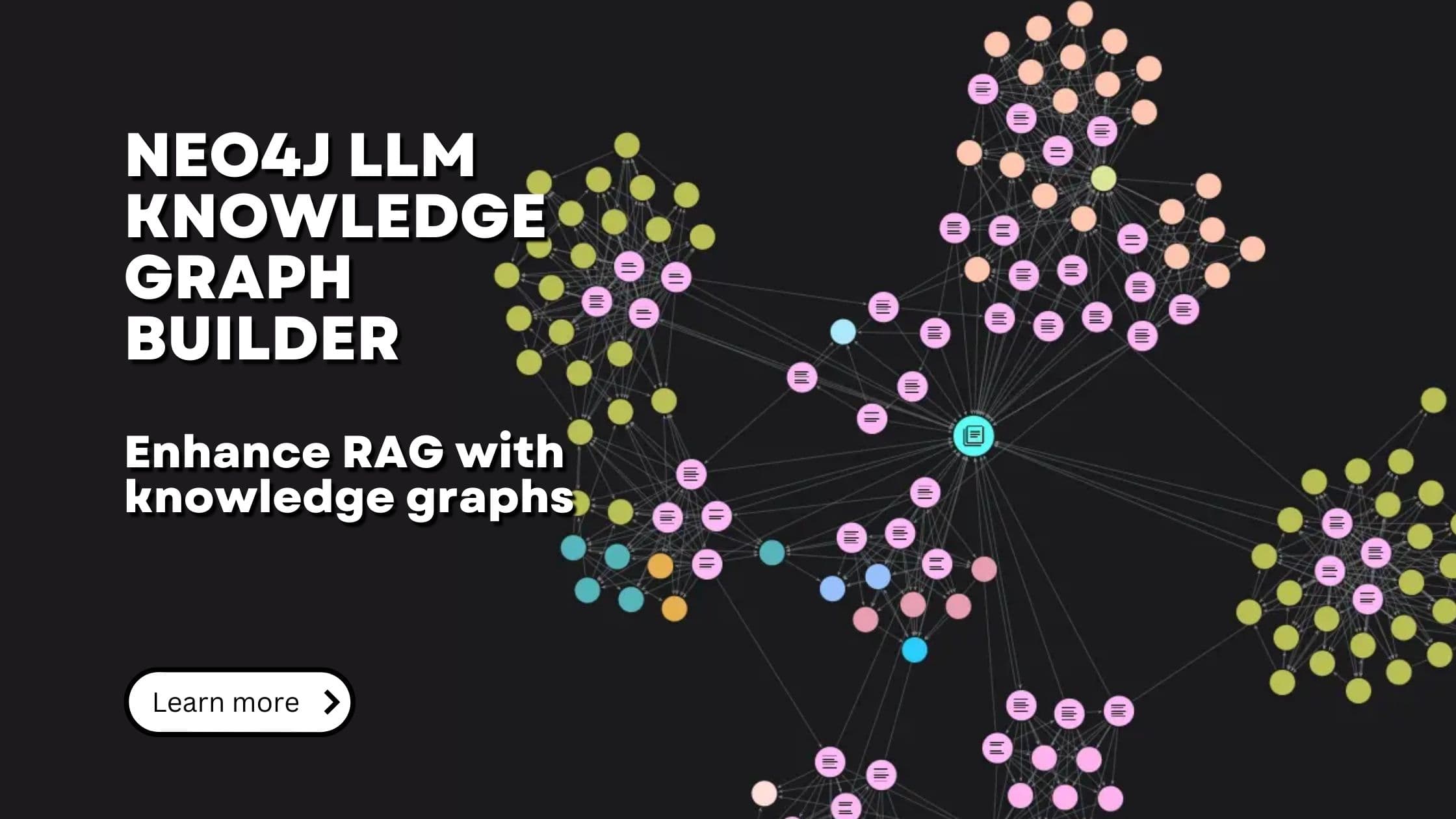
Neo4j LLM Knowledge Graph Builder: How to Create Knowledge Graphs for RAG
Set up the Neo4j LLM Knowledge Graph Builder on AuraDB or Docker, turn a web page into a knowledge graph and query it with GraphRAG in the built-in chat.

BigQuery Text-to-SQL: Query Your Database in Natural Language
Build a text-to-SQL agent for BigQuery in Python: GPT-4o writes the SQL, errors are fed back for self-correction, and RAG picks relevant columns.

How to finetune LLMs
Finetune Llama 3 8B on a single GPU with QLoRA, bitsandbytes and TRL: dataset formats, LoRA and training parameters, full Python script and inference.

LLM Document Extraction: Pull Structured Data from Complex PDFs
Extract text and tables from complex PDFs with an open-source vision LLM: render each page as an image and prompt MiniCPM-Llama3-V 2.5. Python code included.

Using AI directly from your database - with PostgreSQL and pgai
Call OpenAI from PostgreSQL with the pgai extension: create embeddings, summaries and content moderation in plain SQL, plus triggers that embed new rows.

KAN: Is this the end of feedforward networks?
How Kolmogorov-Arnold Networks (KANs) replace MLP weights with learnable splines, what the paper shows on accuracy, and why MLPs aren't done yet.

LLM Safety with Llama Guard 2
Llama Guard 2 is Meta's 8B model for checking LLM prompts and responses. The main attack vectors, its 11 risk categories and how to run it.

How to use AI to create a PowerPoint presentation?
Let GPT-4 write python-pptx code that builds a PowerPoint deck from your company documents via RAG, using your own corporate template.

Vertex AI Agent Builder: What It Is, with a Slack Search Example
What Vertex AI Agent Builder is and what Google calls it today, with a no-code example: index Slack messages and build a Gemini search app.

BitNet: LLM Quantization at its Extreme
How Microsoft's BitNet trains LLMs with 1-bit and ternary weights, why it beats post-training quantization, and what it saves in memory and energy.

Chat with your Confluence: A Step-by-Step Guide using Airbyte, Langchain and PGVector
Build a Confluence chatbot in Python: load pages with PyAirbyte and LangChain's AirbyteLoader, store embeddings in PGVector, answer with GPT-4 Turbo.

Advanced RAG: Improving Retrieval-Augmented Generation with Hypothetical Document Embeddings (HyDE)
HyDE has an LLM write a fake answer document and searches with its embedding instead of the query's. How it works, plus a LlamaIndex example.

GenAI: Technological Masterpiece or Ecological Disaster?
GenAI's energy use is growing fast. The IEA and de Vries numbers, plus the techniques that cut it: TPUs, MoE, distillation, MoD, layer pruning and BitNet.

11 Proven Strategies to Reduce Large Language Model (LLM) Costs
Eleven ways to cut LLM costs, from shorter prompts and semantic caching to quantization, distillation, RAG and chat summaries, plus which one to try first.

How to boost your database performance with OpenAIs new v3 embeddings
OpenAI's v3 embeddings can be shortened thanks to Matryoshka training. Adaptive retrieval uses that for faster vector search: 580 QPS at 99% accuracy.

Introduction to Retrieval Augmented Generators (RAG): Enhancing Virtual Assistants with Domain-Specific Knowledge
How RAG works step by step: ingestion, chunking, embeddings, vector search and the LLM answer, and why it is easier to update than a fine-tuned model.

Advanced RAG: Increase RAG Quality with ColBERT Reranker and llamaindex
Add a ColBERT reranker to a LlamaIndex RAG pipeline: why semantic search ranks the wrong chunks first, and the Python code to rerank them before the LLM call.

Advanced RAG: Recursive Retrieval with llamaindex
Recursive retrieval in LlamaIndex links PDF tables to pandas query engines, so RAG can answer questions from table data. Step-by-step Python example.

vLLM with HTTPS: Self-Host an LLM Behind a Caddy Reverse Proxy
Serve an open-source LLM with vLLM's OpenAI-compatible Docker image and put Caddy in front as a reverse proxy for automatic HTTPS with Let's Encrypt.

RAG Evaluation with Ragas: How to Measure RAG Pipeline Quality
Evaluate a RAG pipeline with Ragas: generate a test set from your documents, then score faithfulness, answer relevancy, context recall and context precision.

Integrating enterprise knowledge with LLMs
Fine-tuning, training your own model or RAG: how each way of adding company knowledge to an LLM works, its pros and cons, and why RAG usually wins.